Research and tool behavior checked against live sources on 2 August 2026. This is general education, not personal financial, tax, immigration, or investment advice.
Imagine leaving work in Japan at 45. Your salary stops, but a residence-tax bill may still be arriving. Your iDeCo balance exists, but it is not your bridge to 60. Your pension is years away. The practical question is whether you have enough accessible resources, at the right times, to choose whether to work—not simply whether you have accumulated a large portfolio.
That is the problem behind FIRE: Financial Independence, Retire Early. The idea is to build enough financial capacity that paid work becomes a choice rather than the condition for paying next month’s bills. “Early” does not have to mean abandoning work forever. It might mean leaving a career, reducing hours, moving somewhere cheaper, or choosing work for interest instead of necessity.
That is the appeal. It is also where the simple version of the conversation ends. Many FIRE discussions begin with a rough 25-times-spending or 4%-withdrawal heuristic. Use it only as an initial illustration, not as a Japan-specific conclusion.
In Japan, the question is not only how much you have saved. It is when each account can be used, what happens to taxes and insurance after your salary stops, whether a later pension covers part of the plan, where you will live, and how foreign assets behave against the yen. Those details are not footnotes. They can change the shape of the plan.
A Japan-specific calculator can make those assumptions visible: taxes, residence tax, health insurance, pension timing, account access, regional costs, currencies, and foreign-resident status. JPFIRECalc is one tool that brings several of those variables into the same scenario. The useful question is not, “What is my number?” but, “Does this plan work because the budget is realistic, because a pension arrives later, because freelance income continues, or because the currency assumption is unusually favourable?”
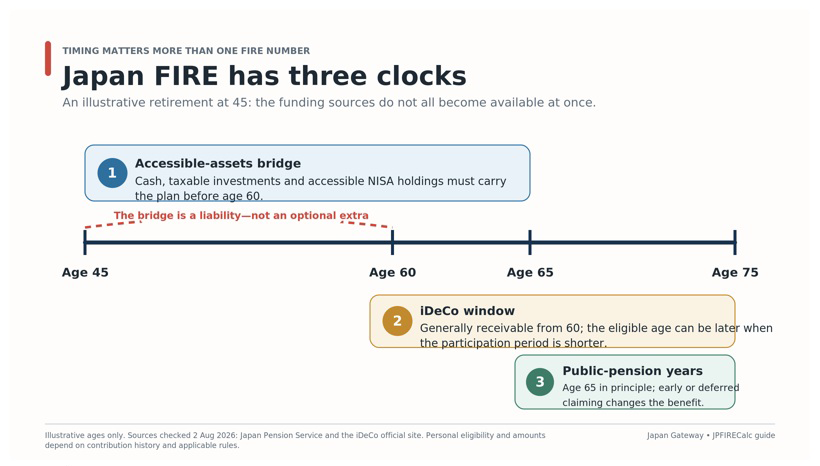
In short: Japan FIRE planning has several clocks running at once—your accessible savings now, locked or tax-advantaged accounts later, and pension income later still. A useful scenario makes those timings visible instead of hiding them inside one FIRE number.
What FIRE means in a Japanese context
The basic idea is familiar. You build enough assets, reduce your dependence on employment income, and eventually work because you choose to rather than because your monthly expenses require it.
Japan changes the planning environment in several ways.
First, your future income may include Japanese public pension. The Japan Pension Service describes old-age basic pension as available from age 65 when the eligibility requirements are met, with early claiming between 60 and 65 and deferred claiming available later. The amount depends on contribution history and the type of pension coverage you have. For someone pursuing FIRE in their thirties or forties, that income is distant—but it can still matter to the later part of the projection.
Second, Japan gives you account structures with different jobs. NISA is designed for tax-free investment gains and dividends within its rules and limits. In the tool’s model, iDeCo is unavailable before age 60; actual receiving eligibility depends on the applicable rules and your participation history. It is not a general-purpose bridge account.
Third, the cost of living is not one national number. Tokyo, Osaka, Fukuoka, Sapporo, a regional city, and a rural town can produce very different budgets. Housing is especially important. A FIRE plan that works in a paid-off regional home may not work in central Tokyo rent, and a rural plan may introduce transport, renovation, or access costs that a city budget hides.
Finally, foreign residents may have an additional layer of tax and administrative complexity. Your tax residence, the source of your income, your pension history in more than one country, social-security agreements, and the tax treaty between Japan and another country can all matter. “I own the asset overseas” is not the same as “Japan does not tax the income.”
Potential advantages of pursuing FIRE in Japan
Potential advantages include regional cost variation, later pension income, and tax-advantaged accounts—provided they are treated as planning inputs rather than slogans.
Regional choice can be a planning lever
Japan offers a wide range of living environments without requiring you to leave the country. A lower-cost city or rural area may reduce some housing and everyday expenses, but the result is location- and household-specific. The trade-off can include transport, heating, repairs, deposits, travel, and access to services. Add those costs to the scenario rather than assuming a rural discount.
It is not free money. Moving can create new costs: a car, heating, repairs, deposits, travel to family, or fewer local job opportunities. Model the place you would actually live, not an abstract “rural Japan” discount.
Public pension can support the later years
A pension is not a substitute for an early-retirement bridge. As a planning inference, a pension beginning later may reduce the portfolio withdrawals required after the claiming age. The effect depends on your contribution record, claim age, and actual estimate.
The important inputs are your contribution record and a realistic estimate. The Japan Pension Service points people toward ねんきんネット for checking their own pension information. Use your statement where possible rather than a generic national average.
NISA and iDeCo give different kinds of leverage
NISA can be useful for long-term investing where you still want access to the money. The Financial Services Agency describes the current NISA as allowing tax-free gains and dividends within the scheme’s limits, with an annual framework and a lifetime holding limit. Because qualifying gains and dividends are tax-free within those rules and limits, NISA may change the tax treatment of withdrawals compared with taxable holdings. It does not remove investment risk.
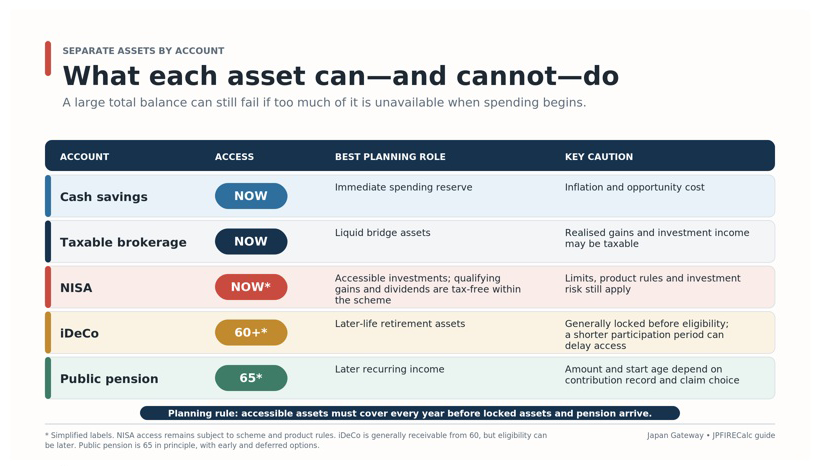
iDeCo can support retirement saving and may provide deductions, but its lock-up is the point. Someone planning to stop working at 45 needs accessible assets for the years before iDeCo can be used. Counting iDeCo as if it were cash available tomorrow is one of the easiest ways to make an early-retirement plan look stronger than it is. For a separate explanation of the two accounts, see our guide to iDeCo and NISA in Japan.
Semi-retirement may fit Japan better than a hard stop
FIRE does not have to mean “never earn another yen.” Part-time work, consulting, seasonal work, a small business, or a lower-paid role can reduce the portfolio draw during the most fragile early years.
The key is to model earned income honestly. Some people use optional earned income as a scenario that could reduce portfolio withdrawals; treat it as uncertain unless the income is contractually reliable. Use a base case with little or no work income.
The same systems that can make a Japan-based plan flexible also create timing, access, and administrative risks.
Japan-specific FIRE pitfalls
The year-one residence-tax shock
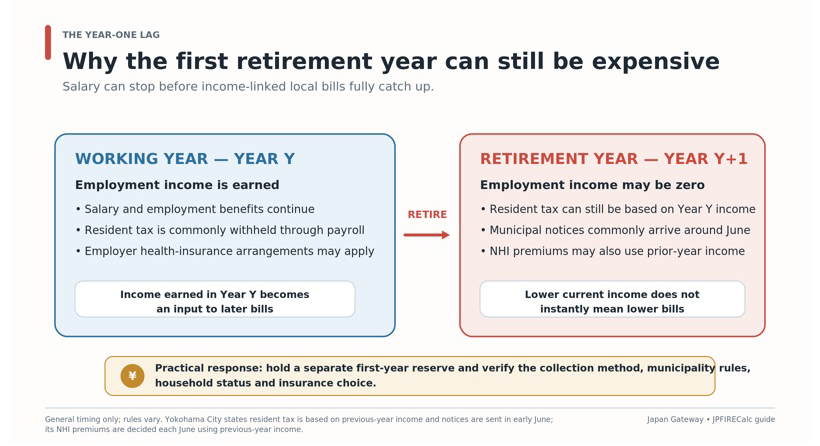
JPFIRECalc flags a possible first-year retirement residence-tax shock: tax linked to your final working-year income may still appear after employment income stops. The amount and collection arrangements depend on your circumstances and municipality.
That means “my salary stopped” does not necessarily mean “my Japanese tax bill stopped.” Hold a separate cash reserve for this possibility and inspect the relevant tax assumptions rather than treating the tool’s estimate as a bill.
Health insurance can move when your income moves
After employment, your coverage and premiums may differ from those during employment. JPFIRECalc includes an NHI-premium estimate in its Japan-specific projections and flags that premiums can vary with withdrawal income. The actual result depends on your post-employment status, municipality, household, and income.
Treat the output as an estimate, not a municipality-issued bill. Confirm the relevant rules and hold a cash reserve if the estimate is material to your plan.
The bridge to age 60 is a real liability
If you retire before 60, your accessible assets must cover the bridge. That includes ordinary living costs, tax, insurance, housing surprises, and the possibility that markets fall immediately after retirement.
NISA may be accessible, but its tax-free limits still matter. Taxable brokerage assets are liquid but may create taxable gains. iDeCo may be valuable later but unavailable when the bridge is doing its most important work.
Sequence of returns matters more than the average
A portfolio that earns a reasonable average return can still fail if poor returns arrive early while withdrawals are high. This is sequence-of-returns risk.
That is why a single projected line is not enough. A Monte Carlo result is not a prophecy, either, but a range of simulated paths can show how sensitive the plan is to the order of returns. Read p10, p50, and p90 as scenario percentiles—not promises that your future will land neatly inside them.
Foreign assets and exchange rates can change the answer
If your spending is in yen while assets or pensions are in another currency, the yen-denominated projection changes when the exchange-rate assumption changes. Test both stronger- and weaker-yen scenarios rather than treating today’s rate as permanent.
The National Tax Agency also makes clear that non-resident taxation and treaty treatment depend on facts such as residence status, income source, and the relevant tax convention. Cross-border FIRE requires more than applying a Japanese tax percentage to every account.
Visa and status questions sit outside a spreadsheet
A financial projection does not grant a right to remain in Japan. Retirement, work, business activity, and residence status are separate questions. If your FIRE plan depends on continuing residence, part-time work, or a particular visa category, verify that issue with an appropriate immigration professional or official source.
Family costs are not a rounding error
JPFIRECalc has spouse, dependent, and education-commitment fields so users can model costs that may not fit a single monthly-expense figure. Their effect will depend on the household scenario.
How to use JPFIRECalc well
A complete first pass looks like this: gather records → create a base case → configure assumptions → run the projection → inspect the displayed metrics and p10/p50/p90 results → create another scenario and change one variable → validate important tax, pension, insurance, and residence assumptions. The first run does not need to be precise. Its job is to reveal which unknowns deserve better estimates.
The steps below describe how to organise a scenario; they do not tell you which account, contribution level, investment, pension age, or residence-status decision is right for you. Open the JPFIRECalc page for context, then start a new JPFIRECalc profile. The tool also provides JSON and CSV templates if you prefer to prepare your figures before entering them.
1. Name the scenario before entering numbers
Use names that describe the assumption, not your mood:
- Base case — Osaka, retire at 50
- Lower spending — Fukuoka, part-time income
- Downside returns — Tokyo rent
- Foreign assets — stronger yen
This makes comparison useful later. The scenario name is part of the analysis.
2. Choose the region, then override it with reality
JPFIRECalc offers regional cost-of-living templates including Tokyo, Osaka, Nagoya, Fukuoka, Sapporo, a secondary city, and rural Japan. The selector supplies a baseline monthly figure; it is not a forecast of your actual spending and is not a municipal tax or NHI calculation. Select the closest starting point, then replace it with your actual or intended budget.
Include rent or mortgage, food, transport, utilities, insurance, travel, hobbies, irregular repairs, and family support. If annual costs are missing, the calculator can produce a precise-looking answer built on an incomplete budget.
3. Enter your personal and employment details
Current age and target retirement age determine the accumulation period and the length of the drawdown. Employment type matters because the tax and income-deduction treatment differs between, for example, company employees and self-employed people.
Enter gross income where requested, then provide social-insurance payments from your payslip or withholding documents if you have them. If you do not know a figure, record that uncertainty and run a conservative alternative rather than treating the default as fact.
4. Separate your assets by account
Enter current balances for:
- 新NISA;
- iDeCo;
- taxable brokerage;
- cash savings;
- foreign assets; and
- optional real estate or other assets.
For NISA, the form distinguishes the current market balance from the lifetime-cap amount used at acquisition cost. That distinction matters: a market-value balance and the amount of quota consumed are not the same number.
For iDeCo, use the tool’s pre-60 access boundary as a planning constraint. Actual receiving eligibility depends on the applicable rules and your participation history. A large iDeCo balance may improve your later-life position without solving your pre-60 bridge.
5. Enter contributions and spending separately
Add monthly expenses, monthly NISA contributions, the annual NISA growth-frame contribution, and monthly iDeCo contributions. Do not hide a large annual payment inside a smooth monthly number if it would create a real cash-flow problem.
If you plan to stop contributions at FIRE, make that clear in the scenario assumptions. The accumulation phase and retirement phase have different cash-flow logic.
6. Add pension information conservatively
The form accepts Japanese pension contribution months, a planned claim age, an optional kosei nenkin estimate, average standard monthly remuneration, and foreign pension income with its start age.
Use your own pension records where possible. The tool lets you compare claim ages. Under the applicable pension rules, deferring can increase the benefit, but it also requires funding more years from other assets first; verify the amount using your own pension record.
7. Use foreigners mode when it applies
If the tool’s Foreigners Mode applies to your situation, it can provide treaty notes, exit-tax warnings, and non-permanent-resident prompts. It does not determine your tax-residency classification, treaty eligibility, asset tax treatment, visa or residence eligibility, or correct exit-tax treatment. Confirm the result against current National Tax Agency guidance and your specific facts. The form also accepts a USD/JPY rate and foreign pension fields.
8. Add temporary commitments explicitly
Education commitments can be entered by beneficiary, annual cost, inflation, start and end years, and notes/source. Use this for costs that should not be buried permanently inside the monthly budget.
A useful note is the source of the number: a school quote, a current rent contract, a pension statement, or simply a planning assumption. That makes later revisions faster and more honest.
9. Save, configure, and run the projection
The form ends with Save & Configure Assumptions; entering the profile is not the same as running the projection. Save the profile, then review the available return, volatility, inflation, tax, and spending assumptions before running it. Save or create separate scenarios for comparison rather than overwriting the base case.
If the dashboard offers a duplicate or new-scenario action, use it to change one material assumption at a time. If it only stores separate scenarios, compare those saved results using the metric labels and units shown by the dashboard.
How to compare and stress-test FIRE scenarios
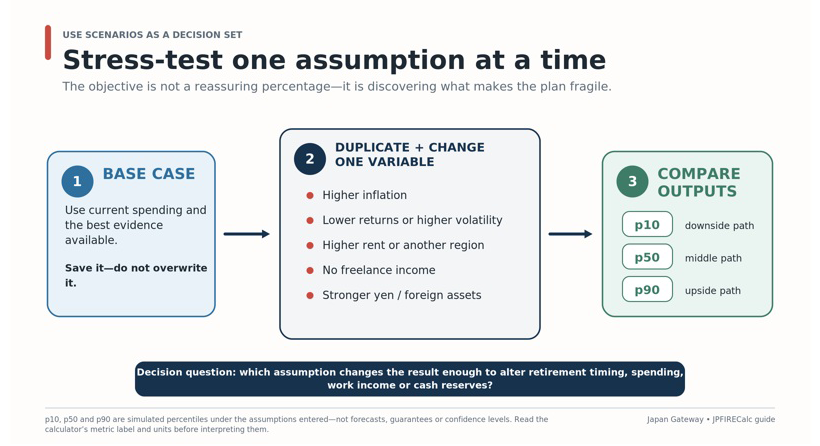
Do not run one scenario and accept the headline output. Build a small decision set.
Start with a base case using current spending and the best evidence you have. Then change one important variable at a time:
- higher inflation;
- lower investment returns;
- lower returns and/or higher volatility;
- an available sequence/return assumption that approximates poor early years;
- higher rent or a different region;
- no freelance income;
- stronger yen against foreign assets;
- later pension claiming; and
- a large one-off family or education commitment.
Compare the saved scenario results using the dashboard’s metric labels and units. You are looking for the assumptions that dominate the outcome. If a modest monthly-spending change materially changes the output, your attention belongs on the budget. If the plan only works with foreign-currency appreciation or permanent freelance income, that dependence should be visible.
Treat p10, p50, and p90 as the tool’s simulated percentiles under the entered assumptions—not as confidence levels or forecasts. Read the metric label and units before interpreting them. The results are only as useful as the return, volatility, inflation, tax, and spending assumptions underneath them.
What JPFIRECalc cannot decide for you
A calculator cannot tell you whether you will enjoy early retirement, whether your partner wants the same life, whether a rural move will suit you, or whether a visa route remains available.
It also cannot know the future rules of NISA, iDeCo, pensions, tax, health insurance, or immigration. Those rules change. The official Financial Services Agency, Japan Pension Service, National Tax Agency, municipality, and relevant professional advisers remain the sources to check before acting.
The best output is not a reassuring percentage. It is a clearer list of conditions:
- This is the spending level the plan can tolerate.
- This is the cash bridge required before age 60.
- This is the pension assumption that matters later.
- This is the tax or insurance shock we have reserved for.
- This is the downside case that would require part-time work or a later retirement date.
That is a much more useful FIRE number than a single multiplication by 25.
A practical starting checklist
A scenario is easier to interpret when it includes:
- a realistic monthly budget, including irregular expenses;
- current balances separated by account type;
- the NISA lifetime-cap figure based on acquisition cost;
- a clear pre-60 bridge if you plan to retire early;
- pension information from your own record where possible;
- a residence-tax reserve for the first year after employment;
- a health-insurance estimate checked against your post-employment status and municipality;
- a currency scenario for foreign assets or pensions;
- a downside return case and an early-bad-years case;
- explicit family, education, housing, and care commitments; and
- a note beside every number you are guessing.
Whether FIRE is feasible depends on the household’s spending, assets, income, timing, and legal and tax circumstances. The calculator is best treated as a way to make those trade-offs visible early enough to examine them.
Sources and further reading
- JPFIRECalc — live Japan-specific FIRE planning tool and standalone link.
- JPFIRECalc standalone calculator — scenario builder and Monte Carlo outputs.
- Financial Services Agency: NISA overview.
- Japan Pension Service international portal.
- Japan Pension Service: old-age pension system (Japanese).
- National Tax Agency: taxation of non-residents.
- National Tax Agency: foreign tax credit for residents.
This article is general information, not personal financial, tax, immigration, or investment advice. Check current rules and your own facts before acting.